

You stand before the bathroom mirror, precision scissors in hand, trying to fix that one stray hair tickling your upper lip. One small slip later, you've trimmed a quarter-inch too high, and the symmetry you spent weeks cultivating is gone in a heartbeat. It's a frustrating reality for many men who find that mustache maintenance often feels more like a high-stakes gamble than a simple grooming routine. I've seen it happen to the best of us, and I understand the sting of a lopsided lip line or the annoyance of hair constantly getting in the way while you eat.
I believe that the craft of grooming shouldn't be a mystery reserved only for the barber's chair. My goal is to share the professional secrets and steady-handed techniques I use every day in my East Village shop so you can maintain that sharp, intentional look at home. In this guide, we'll explore the essential tools that actually work, the logic behind the three-month rule, and the exact steps to achieve a perfectly balanced finish. You'll learn how to master your own ritual, ensuring your mustache remains a mark of character rather than a source of daily stress.
Key Takeaways
- Discover why a curated kit of precision tools is superior to a drawer full of gadgets for achieving a clean, professional lip line.
- Master the fundamental rule of mustache maintenance by always trimming your hair while it's dry to avoid accidental over-shortening.
- Learn how to use mustache wax as a training tool to guide growth away from your mouth rather than using it solely for styling.
- Understand the "Reset Trim" strategy, where a professional barber visit every four weeks simplifies your daily home grooming routine.
What is Mustache Maintenance? Defining the Daily Ritual
To me, mustache maintenance is a quiet form of architecture. It is far more than just keeping hair out of your mouth; it is the deliberate act of preserving the shape, hygiene, and health of your facial hair. In the 2026 grooming landscape, the mustache has emerged as the "thinking man's choice." Whether you are sporting a classic Chevron or a refined Pencil style, choosing to wear a mustache suggests a level of intentionality that a full beard often lacks. There is a profound psychological benefit to this ritual. When you look in the mirror and see a clean, symmetrical lip line, it provides a steady sense of confidence that carries through your entire day.
I often tell my clients that there is a vast difference between simply growing a mustache and curating one. Growing is passive. Curating is a craft. It requires an understanding of how every individual hair contributes to the overall silhouette. When you treat your grooming as a curation, you are no longer just letting hair happen to your face. You are taking ownership of your appearance.
The Anatomy of a Well-Maintained Mustache
Precision begins with understanding the landscape of your own face. You have the lip line, which defines the bottom edge; the philtrum, which is the vertical groove in the center of your upper lip; and the terminals, the far ends where the mustache meets the cheeks. Successful mustache maintenance requires balancing these three areas based on your specific face shape. For example, a square face can handle a denser, wider style, while a longer face might benefit from a thinner, more tailored line. Don't forget the "hidden" hairs either. Those stray strands growing just inside the nostril can quickly disrupt a clean look if they aren't kept in check with regular attention.
Why Precision Matters in the East Village
In my shop in the heart of the East Village, I've seen how a sloppy mustache can instantly diminish even the sharpest haircut. The NYC style is built on precision. We value looks that are sharp, intentional, and meticulously clean around the edges. This neighborhood has a long legacy of barbers who view their work as a dedicated service to the community, blending old-school tradition with modern grit. When your mustache is neglected, it creates a sense of disorder that clashes with a well-executed fade or a professional trim. It is the final detail that signals you are a man who pays attention to the small things.
The Essential Grooming Kit: Precision Tools for the Home Barber
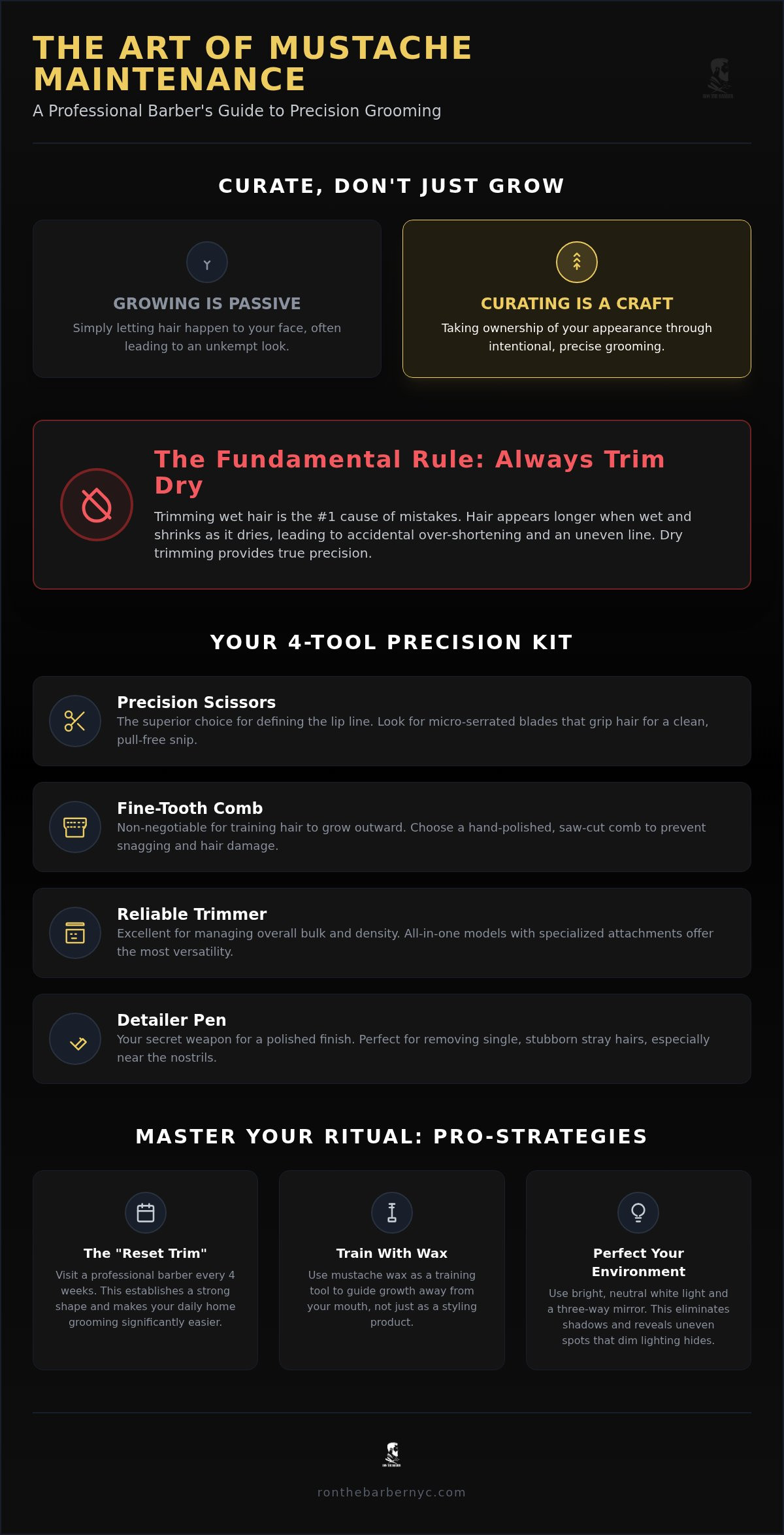
I have seen many men clutter their bathroom cabinets with every gadget marketed to them. It is unnecessary. True mustache maintenance relies on a curated selection of high-quality instruments rather than a mountain of plastic. You only need four core tools to achieve professional results at home: precision scissors, a fine-tooth comb, a reliable trimmer, and a detailer. Quality over quantity is the mantra of the master craftsman. When you invest in the right gear, you are not just buying tools; you are investing in the consistency of your daily presentation.
The most common mistake is using standard household scissors. These are far too bulky to navigate the tight, sensitive curves of the upper lip. Professional facial hair scissors are designed with shorter blades and specific tension to ensure a clean snip without pulling. While electric trimmers are excellent for managing bulk and density, scissors remain the superior choice for the lip line. They provide a level of tactile feedback and control that a vibrating motor simply cannot match. If you find the initial tool selection daunting, you can always visit the shop for a professional Mustache Trim to see these instruments in action before buying your own.
Choosing Your Primary Cutting Tool
When selecting scissors, look for features like tension screws and micro-serrations. A tension screw allows you to adjust the resistance to your preference, while micro-serrations are tiny teeth on the blade that grip the hair, preventing it from sliding away as you snip. For electric trimmers, the 2026 market favors all-in-one models like the Philips Norelco 9000 for their specialized detailing attachments. For those single, stubborn hairs that grow near the nostrils, a detailer pen is your secret weapon for a truly polished finish.
The Supporting Cast: Combs and Mirrors
A fine-tooth comb is non-negotiable for training your hair to grow outward rather than down. Avoid cheap plastic combs; they often have mold-injection seams that snag and damage the hair cuticle. A hand-polished, saw-cut comb is far gentler and more effective. Lighting is equally vital. "Bathroom yellow" bulbs are the enemy of symmetry because they create soft shadows that hide uneven spots. Use bright, neutral white light and a three-way mirror to ensure your mustache looks as good from the profile as it does from the front.
A Step-by-Step Guide to Trimming Your Mustache at Home
I always tell my clients that the most critical rule of mustache maintenance is to never pick up your scissors while the hair is damp. Hair stretches when wet and recoils significantly as it dries. If you trim while wet, you'll likely end up with a lip line much higher than you intended once the hair settles. Start with a dry, clean canvas. Wash your mustache with a mild cleanser to remove any oils or leftover wax, then use your fine-tooth comb to brush every hair straight down toward your lip. This reveals the true length and growth pattern you're working with.
Achieving perfect symmetry requires a methodical approach. I recommend using an "outside-in" technique. Start at the outer corners, known as the terminals, and work your way toward the philtrum in the center. By trimming from the edges toward the middle, you can more easily match the angles on both sides. It's a simple shift in perspective that prevents the common mistake of over-trimming one side while trying to "catch up" to the other.
Mastering the Art of the Lip Line
The lip line is the architectural foundation of a well-curated mustache. You must first decide on the boundary: do you want the hair resting naturally on the top of the lip, or do you prefer a precise 1mm gap for a sharper, more modern look? When you're ready to cut, hold your scissors at a 45-degree angle rather than flat against your face. This creates a natural, textured edge that blends seamlessly, avoiding the harsh, blunt "shelf" look that often results from a horizontal cut.
Managing Bulk and Density
If your mustache feels "bushy" or starts to hang over your mouth in a "curtain effect," you need to manage the density without sacrificing the shape. Use the comb-and-lift method. Gently lift the hair away from your face with your comb and snip only the tips that protrude through the teeth. This thins the bulk while keeping the length intact. Keep a sharp eye out for "rogue" hairs that grow faster than their neighbors. Snip these individually at the base to maintain a consistent surface.
Once you think you're finished, perform the "smile test." Give yourself a wide grin in the mirror. This facial movement reveals hidden hairs that usually stay tucked away but pop out when you speak or eat. Snip those final strays, and your home ritual is complete.
Training Your Hair and Troubleshooting Common Issues
Hair is stubborn. It needs a guide. If you let it grow without intervention, it will eventually curl over your lip and become a daily distraction. Effective mustache maintenance involves more than just the occasional snip; it requires a commitment to training the hair to grow in a specific direction. By encouraging the follicles to lay outward toward the corners of your mouth, you create a cleaner profile and keep your lip line clear of stray strands.
I recommend the "comb and stroke" method as a foundational daily habit. Every morning, after your shower when the hair is most pliable, use your fine-tooth comb to guide the hair away from the philtrum. Follow the comb with your thumb and forefinger, gently stroking the hair into place. This repeated physical guidance, combined with the natural oils from your skin, helps reinforce the desired shape over time. It is a simple ritual that yields significant results if practiced with consistency.
During the early stages of growth, you might encounter the "itchy phase." This discomfort is usually caused by new hairs curling back and irritating the skin or a lack of moisture underneath the bulk. I suggest applying a small amount of beard oil or a dedicated facial moisturizer to soothe the skin. Keeping the area hydrated is just as vital as the hair itself. A healthy foundation ensures that your mustache looks polished rather than dry and brittle.
Mustache Wax 101: Application and Removal
Mustache wax is a misunderstood tool in the grooming kit. Many believe it is reserved for dramatic, theatrical styles, but its primary role for the modern man is providing subtle direction. Start by scraping a tiny amount of wax with your fingernail. Warm it between your thumb and index finger until it reaches a smooth, workable consistency. Apply it from the center outward, remembering that less is more. You want to guide the hair, not coat it in a heavy, greasy film. When it's time to remove the wax, avoid using harsh soaps that strip the hair. Use a warm cloth and a gentle cleanser to dissolve the product while preserving the hair's natural integrity.
Troubleshooting: Asymmetry and Patchiness
It is rare for a mustache to grow perfectly symmetrical. One side may appear denser, or you might find a stubborn cowlick that refuses to lay flat. This is where styling becomes your greatest ally. You can use a small amount of wax to sweep longer hairs over a patchier area, creating the illusion of uniform density. I always advise my clients to follow the "two-week rule." If you notice an uneven spot, wait fourteen days before attempting to trim it away. Often, the surrounding hair simply needs time to fill the space. According to industry standards, it can take four to eight weeks to reach a workable length, so patience is a prerequisite for success. If you're struggling to find the right balance, I can help you establish a solid foundation with a professional Mustache Trim.
Beyond the Mirror: When to Call in the Professional
Even with the best tools and a steady hand, home grooming has its limits. You are viewing your face through a flat, two-dimensional plane, which makes it difficult to judge the three-dimensional symmetry that everyone else sees. Professional mustache maintenance serves as a vital "Reset Trim." Every four weeks, I recommend visiting the shop to re-establish the architectural blueprint of your style. This professional shaping removes the guesswork from your daily ritual, ensuring that you are simply following a clear path rather than trying to forge a new one every morning. It's the difference between maintaining a garden and trying to design one from scratch.
A master's touch is especially important for life's milestones. If you're preparing for a major event, our Wedding Groom Prep Packages provide the meticulous attention to detail that a bathroom mirror cannot offer. There's a quiet confidence that comes from knowing your perimeter has been defined with a straight razor and a steady, experienced hand. It transforms a routine chore into a meaningful experience of self-care. It's about feeling your best when it matters most.
The Value of the Master Barber's Eye
I rely on 4th-generation techniques to ensure your mustache complements your unique facial features. It's about more than just length; it's about balance. By using a straight razor, I can achieve a high-definition perimeter that stays crisp far longer than any electric trimmer. During your visit, I provide a personalized grooming roadmap. We'll discuss how your hair is growing and adjust your home routine to match the current season or a change in your style goals. This expert perspective helps you avoid the common pitfalls of over-trimming or losing your shape over time.
Booking Your Next Precision Trim in NYC
When you sit in my chair in the East Village, the conversation is just as important as the service. Use specific terminology like "Chevron" or "Pencil" to describe your vision, but feel free to ask for my professional opinion on what best fits your face shape. The ritual of the shop, including the scent of the bay rum, the heat of the towel, and the rhythmic snip of the scissors, is a tradition I'm proud to uphold. It's a moment of pause in a busy city. If you feel your home routine has lost its edge, I'm here to restore the precision you deserve. Book your mustache trim at Ron The Barber NYC and let's refine your look together.
Mastering the Art of the Upper Lip
Achieving a refined look is a journey of patience and precision. By choosing the right tools and committing to a dry-trimming ritual, you've taken the first steps toward professional-grade results at home. Remember that effective mustache maintenance is a balance between your daily efforts and the expert eye of a barber. Training your hair to grow with intention ensures that your style remains sharp rather than accidental. I've seen how a few small habits can transform an unruly 'stache into a statement of confidence.
I take immense pride in my 4th-generation barber heritage, bringing a legacy of meticulous care to every individual I serve in the East Village. Whether you need a regular reset or one of my specialized wedding prep packages, I'm here to ensure your grooming reflects your best self. When you're ready to transition from a home ritual to a master's finish, I invite you to visit the shop. Book Your Precision Mustache Trim in the East Village today. Your mustache is a mark of character; let's make sure it's a masterpiece.
Frequently Asked Questions
How often should I perform mustache maintenance at home?
You should aim to perform light mustache maintenance every three to five days to maintain a clean lip line. This frequency prevents stray hairs from becoming a nuisance without the risk of over-trimming. While a professional trim at my East Village shop is best every four weeks, these small home sessions keep your style intentional. Consistent attention ensures you never reach the stage where the hair feels unruly or neglected.
What is the best way to trim a mustache that is too thick?
The most effective way to manage a mustache that has grown too thick is the comb-and-lift method. Use a fine-tooth comb to lift the bulk away from your skin and snip only the tips that protrude through the teeth. This technique reduces density while preserving the overall shape and length. It prevents the "curtain effect" without leaving your facial hair looking sparse or uneven. Precision is key here.
Can I use regular hair wax for my mustache?
I strongly advise against using regular hair wax because it lacks the stiff hold and skin-safe ingredients required for facial hair. Mustache wax is specifically formulated to be safe if tiny amounts are ingested, which is inevitable given its proximity to your mouth. It also provides the necessary tackiness to guide stubborn hairs. Hair products are often too greasy and will fail to hold your style throughout a humid NYC day.
How do I stop my mustache from getting in my mouth when I eat?
To keep hair out of your mouth while eating, you must prioritize training the growth outward and maintaining a precise lip line. Use a small amount of wax daily to sweep the hair toward the corners of your lips. If a few strands remain stubborn, snip them individually at a 45-degree angle. This creates a functional gap that keeps your meals enjoyable without sacrificing the density of your style.
Is it better to use scissors or a trimmer for mustache maintenance?
It's best to use precision scissors for the lip line and an electric trimmer for managing overall bulk. Scissors offer a level of tactile control and accuracy that a trimmer cannot match when you're working near the sensitive edges of your mouth. However, a quality trimmer with the right attachments is excellent for thinning out the top layers. Most master craftsmen use a combination of both for a balanced finish.
What should I do if I accidentally trim my mustache too short?
If you accidentally trim too short, the best course of action is to leave it completely alone for at least two weeks. Resist the urge to "fix" it by trimming the other side to match, as this often leads to a smaller, thinner mustache than you wanted. Let the hair fill back in naturally. Most minor mistakes become unnoticeable to others within a few days as the hair settles and regains its texture.
How do I train my mustache to stay out of my lip line?
Training your mustache requires a daily ritual of combing and light heat. After your shower, comb the damp hair outward from the center and hold it in place with your fingers for a few seconds. Applying a firm-hold wax while the hair is warm helps set the direction as it cools. Over time, the follicles will begin to lay in this new orientation, making your mustache maintenance much easier to manage each morning.
Does mustache maintenance change if I have a beard too?
Mustache maintenance becomes a balancing act when you also have a beard. You must ensure the transition between the mustache terminals and the beard cheeks is seamless and intentional. I often suggest keeping the mustache slightly more defined than the surrounding beard to let it stand out as a focal point. It's vital to maintain the same level of hygiene and hydration for both to ensure a cohesive, professional look.


